
Choose the Implementation Order of SAP SuccessFactors Modules
Updated: Oct 12
Once you have your core People & Culture and Talent Management priorities straight, you can figure out which SuccessFactors modules will deliver on those goals. Here are some common scenarios.

The flexibility of SAP SuccessFactors means that you can implement any module at any time. "Start Small. Thing Big. Act Now."
The Power of SAP SuccessFactors Drives Your People & Culture Experiences
It is Important to Know Where You Want to Go as a strong People and Culture Organization
Having worked with numerous customers to define their implementation roadmaps, I have found that there is a clear need to understand how each module interacts with other SuccessFactors modules and how end to end processes benefit from specific decisions and configurations made during implementation.
Choosing an implementation philosophy
There are a number of ways to approach the implementation order. Consider the following:
1. Implement Employee Central to set the data foundation for your People and Culture processes
2. Fix your burning talent needs
3. Deploy SuccessFactors Workforce Analytics to generate the analytics needed to identify your People and Culture priorities
Although the third step is popular with analytics purists, it is not widely used and it has technical ramifications when implementing the rest of the SuccessFactors modules in the Human Capital Management suite due to the need to regenerate the analytics data cube if the Human Resources Information System data model is different, which is often the case.
Common groupings of SuccessFactors modules
There are groups of modules that make sense to implement together, as summarized in the figure below.
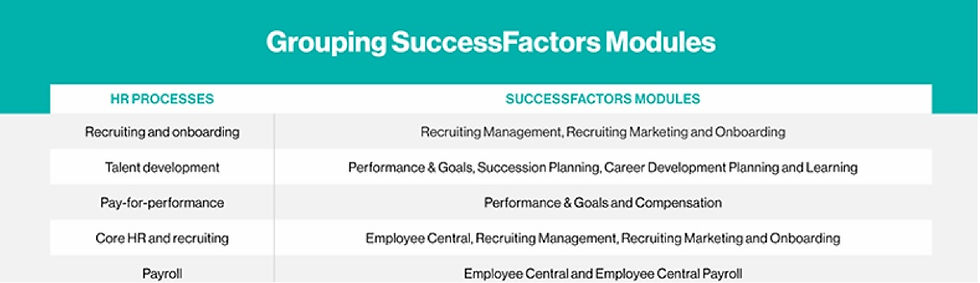
These groups of SuccessFactors modules typically have touch points with each module that influence the overall process or features available to end users. For example, the Career Development module can be influenced by the performance rating from Performance & Goals and can be linked with development goals that include courses in Learning.
The recruiting process often starts with a vacant position, from which a requisition can be created. The candidate who is ultimately selected is then assimilated and hired into the position. Using Employee Central with Recruiting Marketing, Recruiting Management and Onboarding provides a holistic, end to end recruiting and hiring process. You can then manage the position budget in Employee Central Position Management.
When it comes to payroll, the Employee Central data model and the specific Employee Central Payroll integration feature that is being used require the two to be implemented together.
Things to watch out for
Implementing SuccessFactors modules, such as Compensation before Employee Central or Onboarding before Recruiting Management, can sometimes leave you with rework later. Having a compensation planning template built based on your Human Resource Information System could mean rebuilding the template when switching over to Employee Central, particularly if the pay component structure differs between the previous Human Resource Information System and Employee Central.
Essentially, going down any path that might require a process or user interface change within 12 to 18 months is not always going to sit well with employees. For example, having a new hiring process that requires a number of manual steps, instead of implementing SuccessFactors On Boarding as part of the Employee Central implementation, will not make employees feel like the new system is really benefiting them. Future proofing your implementation with the right solution roadmap can be critical to overall adoption by Your People.
Building a roadmap of SuccessFactors modules
Once you have defined a philosophy, figured out your key challenges and determined the right process grouping, then you can build your roadmap as per the below diagram.

The roadmap from one of SAPDAY's Customers shows a core Human Resource, recruiting and payroll scenario in phase 1 and a talent development scenario in phase 2.
It is important to understand where you want to go as a People and Culture organization, but also what the technology offering is and how you can implement it without creating more work or people dissatisfaction later. Identifying the key challenges and overall strategy will allow your roadmap to practically build itself.
About the author
David Borg
SAP SuccessFactors Functional Consultant
SAPDAY New York, USA
email: davidborg@sapday.com


